
A real estate agent coordinates the closing process by managing communication, deadlines, inspections, and paperwork across every party involved in the transaction. This coordination role is

Dated: June 27 2026
Views: 73

Real estate agent commission is a performance-based fee calculated as a percentage of the home's sale price, paid only when the sale closes, and split between the listing agent and the buyer's agent. For buyers and sellers in Northern Virginia, knowing exactly how this fee works, who pays it, and how much room exists to negotiate can save thousands of dollars on a single transaction. The 2024 National Association of Realtors (NAR) settlement changed the rules significantly, making it more important than ever to understand real estate agent commission before you sign anything.
The national average commission sits between 5.46% and 5.7% of the home's sale price, split between the listing agent and the buyer's agent. That percentage means real money on Northern Virginia homes, where prices regularly exceed $600,000.
Here is what those numbers look like in practice:
No commission is paid unless the sale successfully closes. If a deal falls through before settlement, agents walk away without compensation regardless of how many hours they invested. That structure aligns agent incentives with your outcome, which is worth remembering when you evaluate their fees.
Flat-fee and hybrid brokerage models exist and can reduce total costs by 0.5% to 2%, but they usually come with reduced service levels. In a competitive market like Herndon or Reston, where pricing strategy and negotiation skill directly affect your net proceeds, a reduced-service model carries real risk.
Pro Tip: Ask any agent you interview to walk you through their specific commission rate and what services are included. A lower percentage with minimal marketing support can cost you more in final sale price than a full-service agent charging the standard rate.
The 2024 NAR settlement reshaped how buyer-agent compensation works across the country, including Northern Virginia. Before August 2024, sellers routinely covered both their own agent's fee and the buyer's agent fee as a bundled cost. That assumption no longer holds.
The key changes buyers and sellers need to know:
"The 2024 NAR settlement emphasizes transparency and buyer empowerment by requiring written buyer-agent fee agreements before home tours." — Opendoor
This shift places more responsibility on buyers to understand what they are agreeing to pay. In Northern Virginia's fast-moving market, buyers who walk into a home tour without a signed agreement are not legally protected, and agents are not obligated to represent them. Reading that written agreement carefully before you sign is not optional. It is the foundation of your working relationship and your financial exposure.
The commission does not go directly from the seller to the agent. The closing or escrow agent deducts the total commission from the seller's proceeds at settlement and distributes it to the brokerages. Each brokerage then pays its agent according to their internal split agreement.

Here is how the money flows on a $600,000 sale at 5.5% total commission ($33,000):
| Stage | Party receiving payment | Approximate amount |
|---|---|---|
| Total commission collected | Closing agent distributes | $33,000 |
| Listing brokerage receives | Listing broker's share (2.75%) | $16,500 |
| Listing agent receives after split | Agent keeps 60%–80% of broker share | $9,900–$13,200 |
| Buyer's brokerage receives | Buyer broker's share (2.75%) | $16,500 |
| Buyer's agent receives after split | Agent keeps 60%–80% of broker share | $9,900–$13,200 |
Brokerages take 20% to 40% of an agent's share to cover overhead including office space, errors and omissions insurance, licensing fees, and marketing platforms. After those deductions, many agents net only 1% to 1.8% of the home's sale price. On a $600,000 sale, that translates to $6,000 to $10,800 before the agent pays their own business expenses.
Agents are small business owners who fund their own marketing, technology subscriptions, continuing education, and professional memberships out of that net amount. Understanding this context explains why experienced agents are selective about the clients they take on and why deep discounting often signals reduced service.
Pro Tip: When comparing agents, ask about their brokerage split and what tools and marketing resources that brokerage provides. An agent at a well-resourced brokerage with a 70/30 split may deliver more value than a solo agent keeping 90% but working without support.
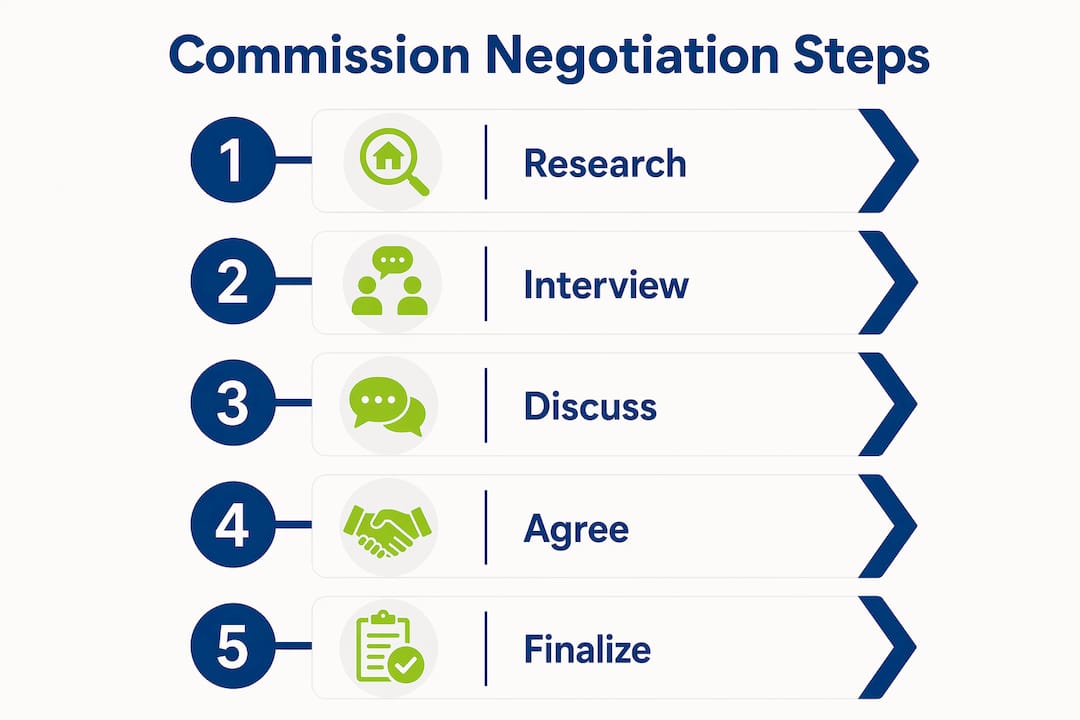
For sellers in Northern Virginia, here is a practical approach:
For buyers navigating the post-2024 environment:
You can also review real estate negotiation strategies to sharpen your approach before sitting down with an agent. Written buyer-broker agreements with explicit compensation terms protect both parties and create a clear foundation for the entire transaction.
Real estate agent commission in Northern Virginia is a negotiable, performance-based fee that flows through brokerages, is paid only at closing, and has been reshaped by the 2024 NAR settlement to require full written disclosure before any agent services begin.
| Point | Details |
|---|---|
| Commission rates are negotiable | No legally mandated rate exists; typical range is 5.46%–5.7%, but terms are set by contract. |
| Payment happens only at closing | Agents receive nothing if the deal falls through, regardless of time invested. |
| Brokerages take 20%–40% first | Agents net far less than the headline rate after brokerage splits and business expenses. |
| 2024 NAR rules changed buyer obligations | Buyers must sign written fee agreements before touring homes and may now negotiate fees directly. |
| Seller concessions remain a viable tool | Sellers can offer closing cost concessions to cover buyer-agent fees without reducing listing commissions. |
Most buyers and sellers walk into commission conversations with one of two misconceptions. Either they think the rate is fixed and non-negotiable, or they assume slashing the commission is always the smart move. Neither is true, and both can cost you.
What I have seen consistently in markets like Herndon, Reston, and Great Falls is that the agent's skill level matters far more than the commission rate. A listing agent who prices your home correctly, markets it aggressively, and negotiates hard on your behalf will almost always net you more money than a discount agent who saves you 1% upfront but leaves money on the table in the final offer.
The 2024 NAR changes have actually created an opportunity for buyers who pay attention. Because buyer-agent fees are now negotiated separately and disclosed in writing, buyers can have a real conversation about value before committing. That transparency is good for everyone. I encourage every buyer I work with to ask their agent directly: what do I get for this fee, and how will you represent my interests when the seller's agent is pushing for a quick close?
The uncomfortable truth is that commission conversations make people uncomfortable, and agents know it. Some rely on that discomfort to avoid the topic entirely. Push through it. Ask the questions. A good agent will welcome the conversation because they are confident in what they deliver.
— Mazin
Understanding how agent fees work is the first step. The second step is working with someone who applies that knowledge to your specific transaction in Herndon, Reston, or Great Falls.

Herndonhomeguide connects you directly with Mazin Abdelhameid, a Northern Virginia real estate professional who brings full transparency to every commission conversation. Whether you are selling a home and want to know exactly how your proceeds are structured, or buying and trying to figure out what your agent agreement actually means, Herndonhomeguide gives you the local expertise and honest guidance you need. Visit Herndonhomeguide to connect with Mazin and get clear answers before your next move.
The national average commission runs between 5.46% and 5.7% of the sale price, and Northern Virginia transactions generally fall within that range. Rates are negotiable and vary based on property type, price point, and the services included.
Since August 2024, sellers are no longer required to cover the buyer's agent fee automatically. Buyers negotiate their agent's compensation directly through a written agreement, though sellers can still offer concessions at closing to help cover those costs.
No. Agents are paid only at closing when the sale successfully completes. If a deal collapses before settlement, the agent receives no commission regardless of the work performed.
Yes. Commission rates are fully negotiable and no legally mandated standard exists. Both listing agreements and buyer-agent agreements are contracts, and every term in them is open to discussion before you sign.
After the brokerage takes its 20% to 40% cut and the agent covers business expenses, most agents net between 1% and 1.8% of the sale price. On a $600,000 home, that translates to roughly $6,000 to $10,800 before personal operating costs.
A real estate agent coordinates the closing process by managing communication, deadlines, inspections, and paperwork across every party involved in the transaction. This coordination role is
What Does Real Estate Seasonality Mean for Buyers?Real estate seasonality is defined as the predictable annual cycle of fluctuations in buyer demand, home inventory, and prices that repeat at
Reston Homeowners Association: 2026 Resident GuideThe Reston Homeowners Association is the primary community organization governing property standards, amenities, and neighborhood rules for most
Work With a Buyer Agent Effectively in 2026A buyer's agent is defined as a licensed real estate professional who represents the buyer's legal and financial interests throughout the entire purchase
 Copyright© 2026 REIN Inc. Information Deemed Reliable But Not Guaranteed. The listings data displayed on this medium comes in part from the Real Estate Information Network Inc.(REIN) and has been authorized by participating listing Broker Members of REIN for display. REIN's listings are based upon Data submitted by its Broker Members, and REIN therefore makes no representation or warranty regarding the accuracy of the Data. All users of REIN's listings database should confirm the accuracy of
the listing information directly with the listing agent. Copyright ©2026 REIN. REIN's listings Data and information is protected under federal copyright laws.Federal law prohibits, among other acts, the unauthorized copying or alteration of, or preparation of derivative works from, all or any part of copyrighted materials, including certain compilations of Data and information. COPYRIGHT VIOLATORS MAY BE SUBJECT TO SEVERE FINES AND PENALTIES
UNDER FEDERAL LAW.
REIN updates its listings on a daily basis. Data last updated: September 21, 2026 1:27 PM UTC
Show More...
Copyright© 2026 REIN Inc. Information Deemed Reliable But Not Guaranteed. The listings data displayed on this medium comes in part from the Real Estate Information Network Inc.(REIN) and has been authorized by participating listing Broker Members of REIN for display. REIN's listings are based upon Data submitted by its Broker Members, and REIN therefore makes no representation or warranty regarding the accuracy of the Data. All users of REIN's listings database should confirm the accuracy of
the listing information directly with the listing agent. Copyright ©2026 REIN. REIN's listings Data and information is protected under federal copyright laws.Federal law prohibits, among other acts, the unauthorized copying or alteration of, or preparation of derivative works from, all or any part of copyrighted materials, including certain compilations of Data and information. COPYRIGHT VIOLATORS MAY BE SUBJECT TO SEVERE FINES AND PENALTIES
UNDER FEDERAL LAW.
REIN updates its listings on a daily basis. Data last updated: September 21, 2026 1:27 PM UTC
Show More...
 All or a portion of the multiple listing information is provided by the Central Virginia Regional Multiple Listing Service, LLC, from a copyrighted compilation of listings. All CVR MLS information provided is deemed reliable but is not guaranteed accurate. The compilation of listings and each individual listing are ©2026 Central Virginia Regional Multiple Listing Service, LLC. All rights reserved.
All MLS listings are © 2026 Central Virginia Regional Multiple Listing Service, LLC. All
rights reserved. No one may copy and/or repost these MLS listings, or any portion thereof, without the written permission of an authorized officer of the Central Virginia Regional Multiple Listing Service, LLC.
All listings with the CVRMLS logo are provided courtesy of the IDX program.
Last Updated: September 21, 2026 1:50 PM UTC
Show More...
All or a portion of the multiple listing information is provided by the Central Virginia Regional Multiple Listing Service, LLC, from a copyrighted compilation of listings. All CVR MLS information provided is deemed reliable but is not guaranteed accurate. The compilation of listings and each individual listing are ©2026 Central Virginia Regional Multiple Listing Service, LLC. All rights reserved.
All MLS listings are © 2026 Central Virginia Regional Multiple Listing Service, LLC. All
rights reserved. No one may copy and/or repost these MLS listings, or any portion thereof, without the written permission of an authorized officer of the Central Virginia Regional Multiple Listing Service, LLC.
All listings with the CVRMLS logo are provided courtesy of the IDX program.
Last Updated: September 21, 2026 1:50 PM UTC
Show More...
 © BRIGHT, All Rights Reserved
Information Deemed Reliable But Not Guaranteed
The data relating to real estate for sale on this website appears in part through the BRIGHT Internet Data Exchange program, a voluntary cooperative exchange of
property listing data between licensed real estate brokerage firms in which
participates, and is provided by BRIGHT through a licensing agreement.
The information provided by this website is for the personal,
non-commercial use of consumers and may not be used for any purpose other than to identify prospective properties consumers may be interested in purchasing.
Data last updated: September 21, 2026 12:41 PM UTC
Some properties which appear for sale on this website may no longer be available
because they are under contract, have Closed or are no longer being offered for sale.
Some real estate firms do not participate in IDX and their listings do not appear on this website. Some properties listed with participating firms do not appear on this website at the request of the seller.
Show More...
