
A real estate agent coordinates the closing process by managing communication, deadlines, inspections, and paperwork across every party involved in the transaction. This coordination role is

Dated: June 26 2026
Views: 31

A listing agent is the licensed real estate professional who exclusively represents the seller in a home sale, managing everything from pricing strategy to closing day coordination. Unlike a buyer's agent, whose loyalty belongs to the purchaser, a listing agent's fiduciary duty runs entirely to you, the seller. Every decision, recommendation, and negotiation move is made to protect your financial interests and get you the strongest possible outcome. Understanding what this role actually involves, and how to choose the right person for it, is one of the most valuable things you can do before putting your home on the market.
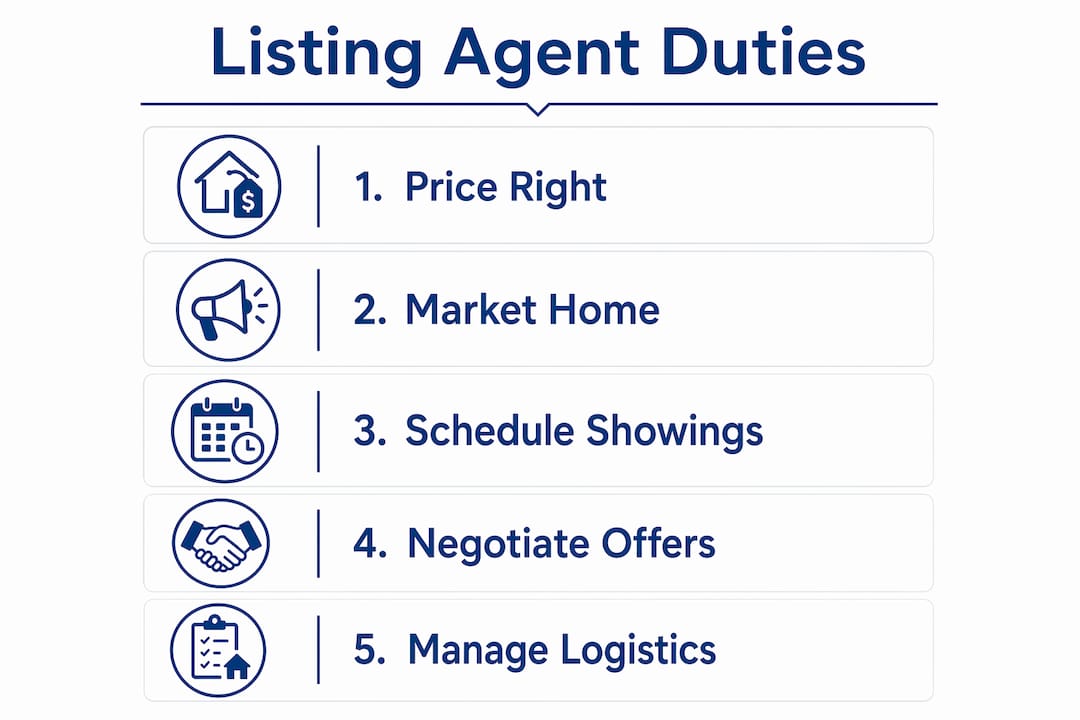
The role of listing agent in a home sale covers far more ground than most sellers realize before they go through the process. The work starts weeks before the property ever hits the market and continues through every step until the deed transfers.
A listing agent begins by performing a Comparative Market Analysis, or CMA. This involves analyzing recent comparable sales and active listings to identify the price range where your home will attract serious buyers without leaving money on the table. Overpricing triggers extended days on market, which signals weakness to buyers and often forces a price reduction that undercuts your negotiating position. Underpricing leaves real money behind. Getting this number right is the single most consequential decision in the entire sale.
Top agents also assess your home with a contractor's mindset, recommending only high-ROI improvements rather than generic decluttering advice. Replacing a dated light fixture in the entryway or refreshing cabinet hardware in the kitchen costs a few hundred dollars and can shift buyer perception significantly. Generic "clean and declutter" advice is table stakes. Specific, targeted prep work is where experienced agents add real value before the photos are even taken.
Once the home is ready, a listing agent executes a multi-channel marketing campaign that includes professional photography, MLS entry, syndication to platforms like Zillow and Realtor.com, social media promotion, and open houses. The quality of that marketing directly affects how many buyers see the home and how quickly competitive offers arrive. A poorly lit phone photo on the MLS is not a neutral choice. It actively reduces buyer interest and suppresses your sale price.

Pro Tip: Ask your listing agent to show you the marketing plan in writing before you sign the listing agreement. A vague answer like "we'll put it on the MLS" is a red flag. You want a specific timeline, a photography plan, and a clear distribution strategy.
After launch, your agent schedules and coordinates showings, collects buyer feedback, and monitors market response. If the home sits without offers, that feedback loop is what tells you whether the issue is price, condition, or presentation. When offers arrive, the agent evaluates each one on price, financing strength, contingencies, and closing timeline. In multiple-offer situations, the agent structures a counteroffer strategy designed to maximize your net proceeds, not just the headline number.
The inspection period is a negotiation phase in its own right. Experienced agents distinguish between repairs that are legally required and cosmetic requests that buyers use to re-trade the price. Offering a modest credit instead of completing a repair often keeps the deal moving while protecting your bottom line.
A listing agent also manages complex transaction logistics including title issues, appraisal disputes, lender coordination, and closing protocols. Most sellers never see this work because a good agent handles it before it becomes a problem. The standard listing agreement typically runs three to six months and entitles the agent to commission only on a successful sale, which aligns their financial incentive directly with yours.
A listing agent's legal obligations are summarized by the OLDCAR acronym: obedience, loyalty, disclosure, confidentiality, accounting, and reasonable care. These are not aspirational values. They are enforceable legal duties, and violating them puts an agent's license at risk and exposes them to civil liability.
The most practically important of these for sellers are loyalty and confidentiality. Loyalty means your agent cannot steer you toward a quick, low offer that closes fast and earns them a commission sooner if that offer is not in your best financial interest. Confidentiality means your agent cannot share your motivation for selling, your timeline pressure, or your pricing floor with the buyer's agent. That information is leverage, and protecting it is a core listing agent duty.
"The listing agent's fiduciary loyalty means steering sellers away from quick low offers that benefit the agent's commission but harm the seller's financial goals." — LegalClarity
One significant shift worth knowing: since 2024, listing agreements no longer automatically guarantee buyer-side compensation. Sellers must now negotiate whether and how much to offer buyer agents, and that decision directly affects how many buyer agents actively show your home. A knowledgeable listing agent will walk you through the options and the tradeoffs clearly, so you make an informed choice rather than a default one.
The financial case for professional representation is direct. Homes sold with a listing agent typically achieve 6 to 13% higher sale prices than for-sale-by-owner transactions. On a $600,000 home in Northern Virginia, that gap represents $36,000 to $78,000 in additional proceeds. Even after commission, the math favors representation in the vast majority of cases.
| Factor | With a listing agent | Without representation (FSBO) |
|---|---|---|
| Pricing accuracy | CMA-based, market-tested pricing | Owner estimate, often off-market |
| Marketing reach | MLS, Zillow, Realtor.com, social media, open houses | Limited to personal network and yard sign |
| Negotiation | Professional, strategy-driven | Emotional, inexperienced |
| Legal paperwork | Managed and reviewed by licensed professional | Owner responsible for compliance |
| Inspection handling | Agent distinguishes required vs. cosmetic repairs | Owner often concedes too much |
| Sale price outcome | Typically 6 to 13% higher than FSBO | Lower average sale price |
Beyond the price difference, a listing agent absorbs the time and stress of managing showings, responding to buyer inquiries, tracking deadlines, and coordinating with title companies, lenders, and inspectors. For sellers who are also managing a job, a family, or a simultaneous purchase, that operational load is not trivial.
Pro Tip: When comparing agent commission to FSBO savings, calculate the net proceeds difference, not the gross commission cost. A 2.5% commission on a $600,000 sale is $15,000. If the agent's expertise adds even 5% to your sale price, that's $30,000 in additional proceeds. The math is rarely close.
Choosing the right agent is where many sellers make their biggest mistake. They hire the first agent who gives them a high price estimate, or they default to a friend or family member without evaluating fit. Here is a structured approach that protects you.
Pro Tip: Ask every agent you interview: "What is your average days on market compared to the neighborhood average?" An agent who consistently sells faster than the market average is executing their pricing and marketing strategy well. An agent who cannot answer this question has not been tracking their own performance.
A listing agent's value in a home sale is measured in dollars, time, and legal protection. The right agent combines pricing expertise, marketing reach, and fiduciary discipline to deliver outcomes that sellers cannot reliably replicate on their own.
| Point | Details |
|---|---|
| Pricing drives everything | A CMA-based price avoids the days-on-market damage that overpricing causes and the lost proceeds that underpricing creates. |
| Marketing quality affects sale price | Multi-channel campaigns including professional photography and MLS syndication directly increase buyer competition and final price. |
| Fiduciary duties are enforceable | OLDCAR obligations legally bind agents to act in your interest, protecting your motivation, timeline, and pricing floor from the buyer. |
| Representation pays for itself | Homes with listing agents sell for 6 to 13% more than FSBO, which typically exceeds commission costs by a wide margin. |
| Post-2024 compensation rules changed | Sellers must now actively negotiate buyer-agent compensation, and a knowledgeable agent is the best guide through that decision. |
Most sellers picture a listing agent as someone who puts a sign in the yard, schedules a few showings, and collects a check at closing. After years of working with sellers in Northern Virginia, I can tell you that picture misses about 80% of the job.
The work that protects your money happens in places you never see. It happens when I push back on a buyer's inspection demand for a $4,000 HVAC credit on a unit that has three years of useful life left. It happens when I decline to share your relocation timeline with a buyer's agent who is fishing for leverage. It happens when I catch a title issue two weeks before closing and get it resolved before it becomes your problem.
What I have found is that sellers who take the time to interview agents carefully, ask hard questions about pricing strategy and marketing plans, and choose based on demonstrated local expertise consistently walk away with better outcomes. The sellers who hire fast, based on a referral or a high price estimate, are the ones who call me six months later wondering what went wrong.
One thing I want every seller to understand: the post-2024 compensation changes are not a reason to avoid offering buyer-agent compensation. They are a reason to have a strategic conversation about it with your agent. In competitive markets like Herndon and Reston, limiting buyer-agent access to your listing to save a percentage point can cost you far more in reduced buyer traffic and weaker offers. That is a tradeoff worth understanding before you make it.
— Mazin
If you are preparing to sell in Herndon, Reston, or Great Falls, the difference between a good outcome and a great one often comes down to the agent you choose and how early you engage them.

Herndonhomeguide.com connects you directly with Mazin Abdelhameid, a local real estate expert with deep knowledge of Northern Virginia's micro-markets. From CMA-based pricing to targeted digital marketing and skilled negotiation, every listing gets a strategy built around your specific goals. Whether you are selling your primary residence or an investment property, you get personalized local expertise and the full scope of listing agent services designed to maximize your net proceeds. Reach out today to start with a no-obligation home valuation.
A listing agent represents the seller exclusively, handling pricing strategy, marketing, showings, offer negotiation, and transaction coordination from listing through closing. Their fiduciary duty legally requires them to act in the seller's best financial interest at every stage.
Homes sold with professional listing agent representation typically achieve 6 to 13% higher sale prices than for-sale-by-owner transactions, which in most cases more than offsets the commission cost.
Listing agent fiduciary duties follow the OLDCAR framework: obedience, loyalty, disclosure, confidentiality, accounting, and reasonable care. Violating these duties risks the agent's license and civil liability.
A standard listing agreement typically runs three to six months, binding the agent to represent the seller exclusively during that period and entitling them to commission only upon a successful sale.
Ask for their CMA methodology, their written marketing plan, their list-to-sale price ratio in your neighborhood, and how they handle buyer-side compensation under the post-2024 industry rules. An agent who cannot answer these questions clearly is not prepared to represent you effectively.
A real estate agent coordinates the closing process by managing communication, deadlines, inspections, and paperwork across every party involved in the transaction. This coordination role is
What Does Real Estate Seasonality Mean for Buyers?Real estate seasonality is defined as the predictable annual cycle of fluctuations in buyer demand, home inventory, and prices that repeat at
Reston Homeowners Association: 2026 Resident GuideThe Reston Homeowners Association is the primary community organization governing property standards, amenities, and neighborhood rules for most
Work With a Buyer Agent Effectively in 2026A buyer's agent is defined as a licensed real estate professional who represents the buyer's legal and financial interests throughout the entire purchase
 Copyright© 2026 REIN Inc. Information Deemed Reliable But Not Guaranteed. The listings data displayed on this medium comes in part from the Real Estate Information Network Inc.(REIN) and has been authorized by participating listing Broker Members of REIN for display. REIN's listings are based upon Data submitted by its Broker Members, and REIN therefore makes no representation or warranty regarding the accuracy of the Data. All users of REIN's listings database should confirm the accuracy of
the listing information directly with the listing agent. Copyright ©2026 REIN. REIN's listings Data and information is protected under federal copyright laws.Federal law prohibits, among other acts, the unauthorized copying or alteration of, or preparation of derivative works from, all or any part of copyrighted materials, including certain compilations of Data and information. COPYRIGHT VIOLATORS MAY BE SUBJECT TO SEVERE FINES AND PENALTIES
UNDER FEDERAL LAW.
REIN updates its listings on a daily basis. Data last updated: September 21, 2026 1:27 PM UTC
Show More...
Copyright© 2026 REIN Inc. Information Deemed Reliable But Not Guaranteed. The listings data displayed on this medium comes in part from the Real Estate Information Network Inc.(REIN) and has been authorized by participating listing Broker Members of REIN for display. REIN's listings are based upon Data submitted by its Broker Members, and REIN therefore makes no representation or warranty regarding the accuracy of the Data. All users of REIN's listings database should confirm the accuracy of
the listing information directly with the listing agent. Copyright ©2026 REIN. REIN's listings Data and information is protected under federal copyright laws.Federal law prohibits, among other acts, the unauthorized copying or alteration of, or preparation of derivative works from, all or any part of copyrighted materials, including certain compilations of Data and information. COPYRIGHT VIOLATORS MAY BE SUBJECT TO SEVERE FINES AND PENALTIES
UNDER FEDERAL LAW.
REIN updates its listings on a daily basis. Data last updated: September 21, 2026 1:27 PM UTC
Show More...
 All or a portion of the multiple listing information is provided by the Central Virginia Regional Multiple Listing Service, LLC, from a copyrighted compilation of listings. All CVR MLS information provided is deemed reliable but is not guaranteed accurate. The compilation of listings and each individual listing are ©2026 Central Virginia Regional Multiple Listing Service, LLC. All rights reserved.
All MLS listings are © 2026 Central Virginia Regional Multiple Listing Service, LLC. All
rights reserved. No one may copy and/or repost these MLS listings, or any portion thereof, without the written permission of an authorized officer of the Central Virginia Regional Multiple Listing Service, LLC.
All listings with the CVRMLS logo are provided courtesy of the IDX program.
Last Updated: September 21, 2026 1:50 PM UTC
Show More...
All or a portion of the multiple listing information is provided by the Central Virginia Regional Multiple Listing Service, LLC, from a copyrighted compilation of listings. All CVR MLS information provided is deemed reliable but is not guaranteed accurate. The compilation of listings and each individual listing are ©2026 Central Virginia Regional Multiple Listing Service, LLC. All rights reserved.
All MLS listings are © 2026 Central Virginia Regional Multiple Listing Service, LLC. All
rights reserved. No one may copy and/or repost these MLS listings, or any portion thereof, without the written permission of an authorized officer of the Central Virginia Regional Multiple Listing Service, LLC.
All listings with the CVRMLS logo are provided courtesy of the IDX program.
Last Updated: September 21, 2026 1:50 PM UTC
Show More...
 © BRIGHT, All Rights Reserved
Information Deemed Reliable But Not Guaranteed
The data relating to real estate for sale on this website appears in part through the BRIGHT Internet Data Exchange program, a voluntary cooperative exchange of
property listing data between licensed real estate brokerage firms in which
participates, and is provided by BRIGHT through a licensing agreement.
The information provided by this website is for the personal,
non-commercial use of consumers and may not be used for any purpose other than to identify prospective properties consumers may be interested in purchasing.
Data last updated: September 21, 2026 12:41 PM UTC
Some properties which appear for sale on this website may no longer be available
because they are under contract, have Closed or are no longer being offered for sale.
Some real estate firms do not participate in IDX and their listings do not appear on this website. Some properties listed with participating firms do not appear on this website at the request of the seller.
Show More...
