
A real estate agent coordinates the closing process by managing communication, deadlines, inspections, and paperwork across every party involved in the transaction. This coordination role is

Dated: June 25 2026
Views: 40

Strong negotiation skills in real estate directly determine how much money buyers save, how much sellers net, and whether deals close at all. The role of negotiation skills in real estate extends far beyond haggling over price. It shapes contingencies, closing timelines, seller credits, and the trust between parties that keeps transactions from falling apart. Skilled negotiation can translate into tens of thousands of dollars in difference on a single transaction. This article covers the frameworks professionals use, including BATNA and anchoring, and how you can apply them whether you are buying, selling, or representing clients in Northern Virginia.
Negotiation in real estate is not a single conversation. It is a series of structured exchanges that begin the moment a buyer submits an offer and continue through inspection, appraisal, and final walkthrough. Each stage creates new leverage points and new opportunities to lose ground if you are unprepared.
Price is the most visible element, but negotiations extend well beyond price to include timing, contingencies, and seller concessions. A buyer who secures a $5,000 seller credit toward closing costs, a 45-day closing window that fits their lease, and a home warranty has captured real value that never shows up in the headline sale price. Sellers, meanwhile, can negotiate to keep appliances, request a rent-back period, or limit repair obligations after inspection.

Agents play a central role in this process. Nearly 90% of buyers and sellers work with agents specifically to get help negotiating price and terms. That statistic reflects a clear market signal: most people recognize they need a skilled intermediary to protect their interests when real money is on the line.
The key leverage points at each stage include:
Pro Tip: Before submitting any offer, identify the two or three terms beyond price that matter most to you. Sellers often have flexibility on closing dates or included items even when they hold firm on price.
BATNA stands for Best Alternative to a Negotiated Agreement. It is the most important concept in negotiation theory, developed by Roger Fisher and William Ury at Harvard's Program on Negotiation, and it applies directly to every real estate deal. Your BATNA is what you will do if the current negotiation fails. Knowing your BATNA prevents you from accepting terms that are worse than your fallback option.
For a buyer, a strong BATNA might be a competing property that meets 90% of their needs at a lower price. For a seller, it could be a rental strategy, a delayed listing, or a backup offer already in hand. The party with the stronger BATNA holds more power in any negotiation because they can walk away without serious consequences.
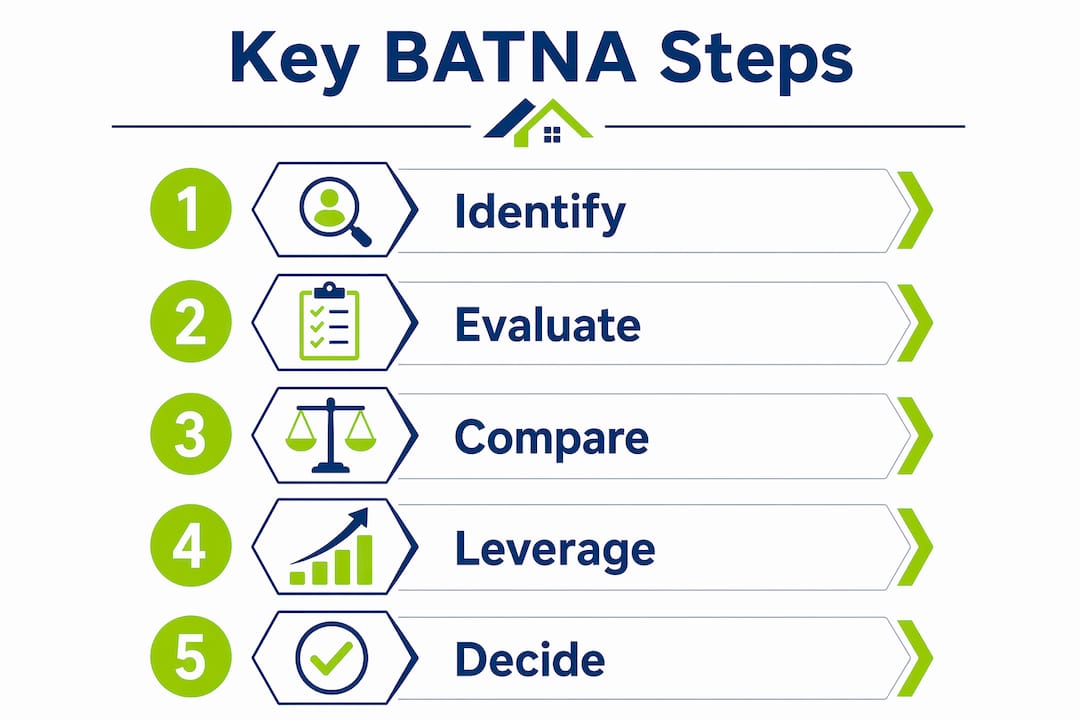
What makes BATNA more complex in practice is that perception of your alternative matters as much as the alternative itself. A buyer who appears desperate, even if they have other options, signals weakness. A seller who seems indifferent to whether the deal closes projects strength. Experienced agents manage this perception deliberately through tone, timing, and the information they choose to share.
A few BATNA principles that apply directly to real estate:
"Negotiation leverage is grounded in knowing your BATNA clearly and not simply trying to be tough." — Program on Negotiation, Harvard Law School
The importance of negotiation in real estate becomes clearest when you look at how top agents and buyers capture value across multiple deal dimensions simultaneously. Price is one variable. A skilled negotiator treats the entire contract as a set of levers.
Anchoring is the single most powerful opening move in any negotiation. The first number in a negotiation strongly shapes the range within which both parties expect to settle. A buyer who opens at $420,000 on a $450,000 listing has anchored the conversation differently than one who opens at $440,000. The anchor does not have to be accepted. It just has to be credible enough to reframe expectations.
The most effective anchoring strategy combines a strong opening position with signals of flexibility. Pairing a high anchor with a proposal range captures more value while preserving goodwill. For example, a seller might counter at "between $455,000 and $465,000 depending on closing timeline," which keeps the anchor high while appearing reasonable.
| Strategy | When to use it | What it captures |
|---|---|---|
| Anchoring with a range offer | Opening counter or first offer | Sets the negotiation ceiling or floor in your favor |
| Seller credits instead of price cuts | Post-inspection or appraisal gap | Preserves sale price while addressing buyer concerns |
| Flexible closing timeline | When seller has moving constraints | Creates goodwill and can justify a higher price |
| Contingency removal offers | Competitive multiple-offer situations | Signals strength and reduces seller risk perception |
Pro Tip: When you hit resistance on price, shift the conversation to terms. Ask what closing date works best for the other party. Solving their timeline problem often unlocks price flexibility you could not get through direct pressure.
Understanding the other party's priorities is the foundation of every advanced real estate negotiation strategy. A seller who needs to close by a specific date values timeline certainty more than a slightly higher price. A buyer relocating for work values speed and certainty over squeezing out the last $2,000. Uncovering and aligning these priorities produces smoother closings and fewer last-minute blowups.
Negotiation skill is not absorbed from reading articles or attending one seminar. It develops through deliberate practice with feedback, repetition, and honest debriefing after real transactions. The gap between knowing a concept and executing it under pressure is where most agents and buyers lose money.
Here is a practical development framework for agents and active buyers or sellers:
The agents who consistently get the best outcomes for clients in markets like Herndon, Reston, and Great Falls are not the most aggressive. They are the most prepared. They know their client's BATNA, they have studied comparable sales, and they have already mapped the other party's likely priorities before the first counteroffer arrives. For buyers looking to master real estate negotiation tactics, the investment in preparation pays off directly in deal outcomes.
Negotiation skill in real estate is a measurable competitive advantage that determines price, terms, and whether deals close at all.
| Point | Details |
|---|---|
| Negotiation spans the full transaction | Price, timeline, contingencies, and credits are all negotiable at every stage from offer to closing. |
| BATNA defines your real leverage | Know your concrete fallback plan before entering any negotiation, and manage how the other party perceives it. |
| Anchoring sets the range | The first credible number in a negotiation shapes the entire settlement zone, so open with intention. |
| Priorities beat price pressure | Uncovering what the other party actually needs often unlocks concessions that direct price haggling cannot. |
| Practice builds real skill | Roleplay, debrief, and structured repetition develop the discipline needed to perform under transaction pressure. |
I have worked through enough transactions in Northern Virginia to say this with confidence: the deals that fall apart almost never fail because of price. They fail because someone got emotional at the wrong moment, or because neither party understood what the other actually needed.
The buyers I see struggle most are the ones who treat every negotiation as a battle. They anchor aggressively without market data to back it up, they push on inspection items that are clearly cosmetic, and they signal desperation through their agent's communication style. The result is sellers who dig in, deals that collapse, and clients who end up paying more for a different property than they would have paid on the original one.
What actually works is preparation so thorough that you are never surprised. Before any offer goes in, I want to know the seller's timeline, whether they have had previous offers, and what their carrying costs look like. That information shapes every decision from opening offer to final walkthrough. Emotional intelligence is not a soft skill in this context. It is a tactical asset. Knowing when to push and when to give ground on a small item to protect a larger one is the difference between a closed deal and a dead one.
The agents who consistently outperform in competitive markets are not the loudest. They are the ones who have done the work before the conversation starts.
— Mazin

At Herndonhomeguide, negotiation is not an afterthought. It is built into every stage of how we represent buyers and sellers in Herndon, Reston, and Great Falls. Mazin Abdelhameid brings deep local market knowledge and a structured approach to every offer, counteroffer, and inspection conversation. Whether you are trying to buy in a competitive multiple-offer situation or sell at the top of your market's range, the outcome depends on how well your agent negotiates on your behalf. Visit Herndonhomeguide to connect directly with Mazin and get representation that treats every deal term as an opportunity to maximize your result.
Negotiation skills determine the final price, terms, contingencies, and closing conditions of a real estate transaction. Strong skills can shift outcomes by tens of thousands of dollars on a single deal.
BATNA stands for Best Alternative to a Negotiated Agreement. It defines what you will do if a deal falls through, and knowing it clearly prevents you from accepting terms worse than your fallback option.
Anchoring means the first number in a negotiation sets the range within which both parties expect to settle. A credible opening offer or counteroffer shapes the entire negotiation, so the first move carries significant strategic weight.
Buyers can negotiate closing timelines, seller credits toward closing costs, contingency terms, included appliances, and repair obligations. Focusing only on price leaves significant value on the table.
Agents improve through deliberate roleplay of friction scenarios, structured debriefs after each transaction, and building prepared responses to common pressure points like low appraisals and inspection pushback.
A real estate agent coordinates the closing process by managing communication, deadlines, inspections, and paperwork across every party involved in the transaction. This coordination role is
What Does Real Estate Seasonality Mean for Buyers?Real estate seasonality is defined as the predictable annual cycle of fluctuations in buyer demand, home inventory, and prices that repeat at
Reston Homeowners Association: 2026 Resident GuideThe Reston Homeowners Association is the primary community organization governing property standards, amenities, and neighborhood rules for most
Work With a Buyer Agent Effectively in 2026A buyer's agent is defined as a licensed real estate professional who represents the buyer's legal and financial interests throughout the entire purchase
 Copyright© 2026 REIN Inc. Information Deemed Reliable But Not Guaranteed. The listings data displayed on this medium comes in part from the Real Estate Information Network Inc.(REIN) and has been authorized by participating listing Broker Members of REIN for display. REIN's listings are based upon Data submitted by its Broker Members, and REIN therefore makes no representation or warranty regarding the accuracy of the Data. All users of REIN's listings database should confirm the accuracy of
the listing information directly with the listing agent. Copyright ©2026 REIN. REIN's listings Data and information is protected under federal copyright laws.Federal law prohibits, among other acts, the unauthorized copying or alteration of, or preparation of derivative works from, all or any part of copyrighted materials, including certain compilations of Data and information. COPYRIGHT VIOLATORS MAY BE SUBJECT TO SEVERE FINES AND PENALTIES
UNDER FEDERAL LAW.
REIN updates its listings on a daily basis. Data last updated: September 21, 2026 1:27 PM UTC
Show More...
Copyright© 2026 REIN Inc. Information Deemed Reliable But Not Guaranteed. The listings data displayed on this medium comes in part from the Real Estate Information Network Inc.(REIN) and has been authorized by participating listing Broker Members of REIN for display. REIN's listings are based upon Data submitted by its Broker Members, and REIN therefore makes no representation or warranty regarding the accuracy of the Data. All users of REIN's listings database should confirm the accuracy of
the listing information directly with the listing agent. Copyright ©2026 REIN. REIN's listings Data and information is protected under federal copyright laws.Federal law prohibits, among other acts, the unauthorized copying or alteration of, or preparation of derivative works from, all or any part of copyrighted materials, including certain compilations of Data and information. COPYRIGHT VIOLATORS MAY BE SUBJECT TO SEVERE FINES AND PENALTIES
UNDER FEDERAL LAW.
REIN updates its listings on a daily basis. Data last updated: September 21, 2026 1:27 PM UTC
Show More...
 All or a portion of the multiple listing information is provided by the Central Virginia Regional Multiple Listing Service, LLC, from a copyrighted compilation of listings. All CVR MLS information provided is deemed reliable but is not guaranteed accurate. The compilation of listings and each individual listing are ©2026 Central Virginia Regional Multiple Listing Service, LLC. All rights reserved.
All MLS listings are © 2026 Central Virginia Regional Multiple Listing Service, LLC. All
rights reserved. No one may copy and/or repost these MLS listings, or any portion thereof, without the written permission of an authorized officer of the Central Virginia Regional Multiple Listing Service, LLC.
All listings with the CVRMLS logo are provided courtesy of the IDX program.
Last Updated: September 21, 2026 1:50 PM UTC
Show More...
All or a portion of the multiple listing information is provided by the Central Virginia Regional Multiple Listing Service, LLC, from a copyrighted compilation of listings. All CVR MLS information provided is deemed reliable but is not guaranteed accurate. The compilation of listings and each individual listing are ©2026 Central Virginia Regional Multiple Listing Service, LLC. All rights reserved.
All MLS listings are © 2026 Central Virginia Regional Multiple Listing Service, LLC. All
rights reserved. No one may copy and/or repost these MLS listings, or any portion thereof, without the written permission of an authorized officer of the Central Virginia Regional Multiple Listing Service, LLC.
All listings with the CVRMLS logo are provided courtesy of the IDX program.
Last Updated: September 21, 2026 1:50 PM UTC
Show More...
 © BRIGHT, All Rights Reserved
Information Deemed Reliable But Not Guaranteed
The data relating to real estate for sale on this website appears in part through the BRIGHT Internet Data Exchange program, a voluntary cooperative exchange of
property listing data between licensed real estate brokerage firms in which
participates, and is provided by BRIGHT through a licensing agreement.
The information provided by this website is for the personal,
non-commercial use of consumers and may not be used for any purpose other than to identify prospective properties consumers may be interested in purchasing.
Data last updated: September 21, 2026 12:41 PM UTC
Some properties which appear for sale on this website may no longer be available
because they are under contract, have Closed or are no longer being offered for sale.
Some real estate firms do not participate in IDX and their listings do not appear on this website. Some properties listed with participating firms do not appear on this website at the request of the seller.
Show More...
