
A real estate agent coordinates the closing process by managing communication, deadlines, inspections, and paperwork across every party involved in the transaction. This coordination role is

Dated: June 23 2026
Views: 1981

A closing cost credit is money the seller agrees to apply toward your closing costs at settlement, reducing the cash you need to bring to the table without lowering the home's purchase price. In Northern Virginia, where a median home purchase can push $550,000 or more, closing costs typically run 2% to 5% of the purchase price. That translates to $11,000 to $27,500 in upfront expenses on a $550,000 home. A well-negotiated seller concession, the formal industry term for this arrangement, can absorb a significant portion of those real estate closing fees and keep your savings intact for moving costs, repairs, or your first mortgage payment.
A closing cost credit appears as a line item on your Closing Disclosure, the official settlement document your lender provides three business days before closing. The credit reduces the seller's net proceeds and is legally recorded in the transaction. No cash changes hands between buyer and seller directly. Instead, the credit offsets specific fees listed on your settlement statement, such as lender origination charges, title insurance, and prepaid escrow deposits.
One critical rule: credits cannot fund your down payment. Lenders treat the down payment and closing costs as two separate categories, and mixing them violates underwriting guidelines. The credit applies only to approved closing costs and prepaid items.
What happens if the negotiated credit exceeds your actual closing costs? The surplus must be applied to lender-approved prepaid items or loan discount points. The lender cannot hand you the difference as cash. This is why working with your lender before you finalize a credit amount is non-negotiable.

Every loan program sets a ceiling on how much a seller can contribute. Exceeding these caps triggers a loan condition or outright denial.
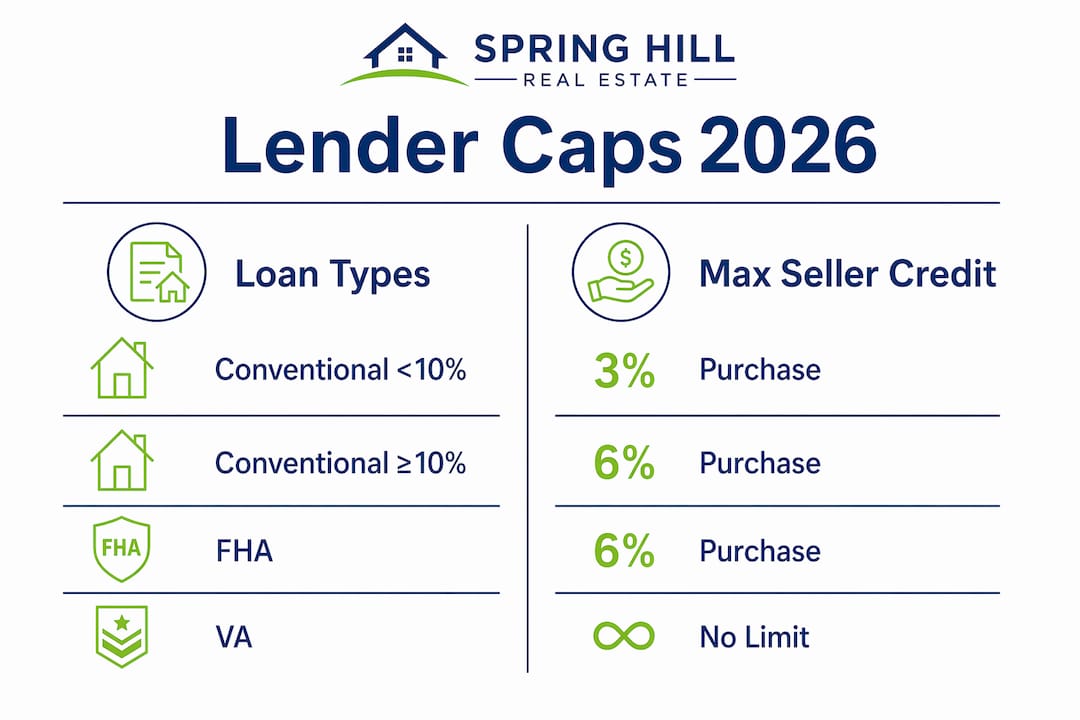
| Loan Type | Maximum Seller Credit |
|---|---|
| Conventional (less than 10% down) | 3% of purchase price |
| Conventional (10%–25% down) | 6% of purchase price |
| Conventional (over 25% down) | 9% of purchase price |
| FHA | 6% of purchase price |
| VA | All allowable closing costs plus 4% |
| USDA | Negotiable, typically up to 6% |
Source: Seller Credit Limits by Loan Type
These caps exist because lenders view inflated credits as a way to artificially raise the purchase price. A $10,000 credit on a $400,000 FHA purchase is within the 6% limit. A $30,000 credit on the same deal is not.
Pro Tip: Ask your lender for the exact dollar cap on seller credits before you write your offer. Knowing your ceiling prevents you from requesting an amount that could stall your loan approval.
Most first-time buyers assume a lower purchase price is always the better deal. The math tells a different story in many situations. A $10,000 price reduction on a $500,000 home lowers your monthly payment by roughly $50 to $60 on a 30-year mortgage. That same $10,000 as a closing cost credit eliminates $10,000 in cash you need at closing today.
Credits let buyers effectively finance their closing costs rather than paying them out of pocket. This matters most when you are cash-constrained but income-qualified. You can afford the monthly payment but struggle to cover both the down payment and $15,000 in closing fees simultaneously.Credits also protect the appraisal. When a seller reduces the price, the appraised value must support the new number. A credit keeps the contract price intact, which means the appraisal target stays the same. In a market like Herndon or Reston, where appraisals can be tight on fast-moving properties, this stability matters.
Here is when a price reduction makes more sense:
Here is when a closing cost credit wins:
A seller concession can cover most of the fees that appear on your Closing Disclosure. Typical closing costs include lender fees, title insurance, escrow, appraisal, prepaid taxes, and insurance premiums. In Northern Virginia, title insurance and government recording fees tend to be higher than the national average, making credits especially valuable here.
Specific costs a credit can cover:
What a credit cannot cover:
Pro Tip: Request a Loan Estimate from your lender before negotiating a credit amount. The Loan Estimate itemizes every expected fee, so you know exactly how large a credit you can use without leaving money on the table.
The best time to request a closing cost credit is in your initial offer, not after the contract is signed. Incorporating the credit request in the contract terms from the start sets clear expectations and avoids renegotiation friction later. In a competitive Northern Virginia market, a credit request paired with a full-price offer is often more palatable to sellers than a lowball price.
Follow these steps to negotiate effectively:
A common pitfall is misunderstanding credit limits, leading buyers to request amounts that lenders disallow. This risks delays or, in worst cases, loan denial. Your real estate agent and lender need to be aligned before you submit any offer with a credit request.
A closing cost credit reduces your upfront cash at closing by applying a seller-funded credit to your settlement fees, without changing your loan amount or purchase price.
| Point | Details |
|---|---|
| Credits reduce cash at closing | A seller credit offsets lender fees, title costs, and prepaid expenses so you bring less cash to settlement. |
| Lender caps vary by loan type | FHA allows up to 6%, VA covers all allowable costs plus 4%, and conventional caps range from 3% to 9% based on down payment. |
| Credits beat price reductions for cash-strapped buyers | A $10,000 credit saves $10,000 today; the same price cut saves roughly $50 per month over 30 years. |
| Down payments are off-limits | Credits apply strictly to closing costs and prepaid items. Using them for a down payment violates underwriting rules. |
| Negotiate early and coordinate with your lender | Request the credit in your initial offer and confirm the allowable amount with your lender before signing anything. |
Working with first-time buyers in Herndon, Reston, and Great Falls has taught me one consistent lesson: buyers who understand seller concessions before they write their first offer have a measurable advantage over those who discover them after the fact.
The most effective use of a closing cost credit I have seen was a buyer using a VA loan who negotiated a credit covering all allowable closing costs plus two discount points to buy down the rate. The seller kept the full asking price, the buyer walked in with minimal cash out of pocket, and the rate buydown lowered the monthly payment for the life of the loan. That is a scenario where everyone wins, but it only works when the buyer, agent, and lender are coordinating from day one.
My honest advice: do not treat a credit as an afterthought you tack on after inspection. Build it into your offer strategy from the start. In a market where sellers are fielding multiple offers, a full-price offer with a credit request is often more competitive than a reduced-price offer with no concessions. Sellers care about their net proceeds, not the gross price. If the numbers work out the same for them, most will take the cleaner deal.
One more thing worth saying plainly: credits are not free money. The seller factors the credit into their net, and in some cases, the purchase price is adjusted upward to accommodate it. Know what you are actually getting and make sure the appraisal can support the contract price.
— Mazin
Negotiating a closing cost credit in Northern Virginia requires knowing local lender rules, reading the seller's motivation correctly, and timing the request precisely. These are skills that come from doing this work in this specific market, not from reading general guides.

Herndonhomeguide connects first-time buyers directly with Mazin Abdelhameid, a local real estate professional who knows the Herndon, Reston, and Great Falls markets in detail. From structuring your initial offer to coordinating credit limits with your lender, having the right local expert in your corner can mean the difference between a smooth closing and a stressful one. Reach out through Herndonhomeguide before you write your first offer and start the process with a clear strategy.
A closing cost credit is a seller concession that reduces the buyer's out-of-pocket expenses at closing by applying a credit on the settlement statement. It does not lower the purchase price or the loan amount.
Closing cost credits are generally not taxable income for the buyer. The IRS treats them as a reduction in the purchase price for tax purposes, though you should confirm your specific situation with a tax advisor.
No. If the credit exceeds your actual closing costs, the surplus must be redirected to prepaid items or discount points. The lender cannot return the excess as cash to the buyer.
Request the credit as part of your initial offer rather than as a post-inspection demand. Pairing a full-price offer with a credit request is often more acceptable to sellers than a price reduction, since their net proceeds can end up similar.
Conventional, FHA, VA, and USDA loans all permit seller credits, but each program sets different caps. VA loans are the most flexible, covering all allowable closing costs plus up to 4% in additional concessions. Always confirm the limit for your specific loan with your lender before negotiating.
A real estate agent coordinates the closing process by managing communication, deadlines, inspections, and paperwork across every party involved in the transaction. This coordination role is
What Does Real Estate Seasonality Mean for Buyers?Real estate seasonality is defined as the predictable annual cycle of fluctuations in buyer demand, home inventory, and prices that repeat at
Reston Homeowners Association: 2026 Resident GuideThe Reston Homeowners Association is the primary community organization governing property standards, amenities, and neighborhood rules for most
Work With a Buyer Agent Effectively in 2026A buyer's agent is defined as a licensed real estate professional who represents the buyer's legal and financial interests throughout the entire purchase
 Copyright© 2026 REIN Inc. Information Deemed Reliable But Not Guaranteed. The listings data displayed on this medium comes in part from the Real Estate Information Network Inc.(REIN) and has been authorized by participating listing Broker Members of REIN for display. REIN's listings are based upon Data submitted by its Broker Members, and REIN therefore makes no representation or warranty regarding the accuracy of the Data. All users of REIN's listings database should confirm the accuracy of
the listing information directly with the listing agent. Copyright ©2026 REIN. REIN's listings Data and information is protected under federal copyright laws.Federal law prohibits, among other acts, the unauthorized copying or alteration of, or preparation of derivative works from, all or any part of copyrighted materials, including certain compilations of Data and information. COPYRIGHT VIOLATORS MAY BE SUBJECT TO SEVERE FINES AND PENALTIES
UNDER FEDERAL LAW.
REIN updates its listings on a daily basis. Data last updated: September 21, 2026 1:27 PM UTC
Show More...
Copyright© 2026 REIN Inc. Information Deemed Reliable But Not Guaranteed. The listings data displayed on this medium comes in part from the Real Estate Information Network Inc.(REIN) and has been authorized by participating listing Broker Members of REIN for display. REIN's listings are based upon Data submitted by its Broker Members, and REIN therefore makes no representation or warranty regarding the accuracy of the Data. All users of REIN's listings database should confirm the accuracy of
the listing information directly with the listing agent. Copyright ©2026 REIN. REIN's listings Data and information is protected under federal copyright laws.Federal law prohibits, among other acts, the unauthorized copying or alteration of, or preparation of derivative works from, all or any part of copyrighted materials, including certain compilations of Data and information. COPYRIGHT VIOLATORS MAY BE SUBJECT TO SEVERE FINES AND PENALTIES
UNDER FEDERAL LAW.
REIN updates its listings on a daily basis. Data last updated: September 21, 2026 1:27 PM UTC
Show More...
 All or a portion of the multiple listing information is provided by the Central Virginia Regional Multiple Listing Service, LLC, from a copyrighted compilation of listings. All CVR MLS information provided is deemed reliable but is not guaranteed accurate. The compilation of listings and each individual listing are ©2026 Central Virginia Regional Multiple Listing Service, LLC. All rights reserved.
All MLS listings are © 2026 Central Virginia Regional Multiple Listing Service, LLC. All
rights reserved. No one may copy and/or repost these MLS listings, or any portion thereof, without the written permission of an authorized officer of the Central Virginia Regional Multiple Listing Service, LLC.
All listings with the CVRMLS logo are provided courtesy of the IDX program.
Last Updated: September 21, 2026 1:50 PM UTC
Show More...
All or a portion of the multiple listing information is provided by the Central Virginia Regional Multiple Listing Service, LLC, from a copyrighted compilation of listings. All CVR MLS information provided is deemed reliable but is not guaranteed accurate. The compilation of listings and each individual listing are ©2026 Central Virginia Regional Multiple Listing Service, LLC. All rights reserved.
All MLS listings are © 2026 Central Virginia Regional Multiple Listing Service, LLC. All
rights reserved. No one may copy and/or repost these MLS listings, or any portion thereof, without the written permission of an authorized officer of the Central Virginia Regional Multiple Listing Service, LLC.
All listings with the CVRMLS logo are provided courtesy of the IDX program.
Last Updated: September 21, 2026 1:50 PM UTC
Show More...
 © BRIGHT, All Rights Reserved
Information Deemed Reliable But Not Guaranteed
The data relating to real estate for sale on this website appears in part through the BRIGHT Internet Data Exchange program, a voluntary cooperative exchange of
property listing data between licensed real estate brokerage firms in which
participates, and is provided by BRIGHT through a licensing agreement.
The information provided by this website is for the personal,
non-commercial use of consumers and may not be used for any purpose other than to identify prospective properties consumers may be interested in purchasing.
Data last updated: September 21, 2026 12:41 PM UTC
Some properties which appear for sale on this website may no longer be available
because they are under contract, have Closed or are no longer being offered for sale.
Some real estate firms do not participate in IDX and their listings do not appear on this website. Some properties listed with participating firms do not appear on this website at the request of the seller.
Show More...
