
A real estate agent coordinates the closing process by managing communication, deadlines, inspections, and paperwork across every party involved in the transaction. This coordination role is

Dated: June 23 2026
Views: 18

The right questions to ask your listing agent are the single most effective tool you have for protecting your interests, maximizing your sale price, and avoiding costly contract surprises in Northern Virginia's competitive real estate market. A listing agent, formally called a seller's agent or seller's representative, is the licensed professional you authorize to market and sell your home on your behalf. The listing agreement you sign with that agent defines the entire relationship, covering authority, services, compensation, and performance expectations. In Virginia, that agreement must be written, include a definite termination date, and disclose all fees. Skipping the interview process, or asking the wrong questions, puts all of that at risk.
Choosing an agent based on a yard sign or a referral without asking direct questions is one of the most common and expensive mistakes Northern Virginia sellers make. The right inquiries expose whether an agent actually knows Herndon, Reston, or Great Falls, or whether they are simply licensed to work there.
Start with these core questions:
Volume matters, but local volume matters more. An agent who closed 40 transactions last year in Loudoun County is not the same as one who closed 15 in Herndon. Neighborhood-specific knowledge affects pricing accuracy, buyer pool targeting, and negotiation leverage. Client references and reviews from sellers in comparable price ranges give you the most direct evidence of an agent's real-world performance.
Pro Tip: Send the agent a text or email before your first meeting and note how quickly they respond. An agent who takes 36 hours to reply to a prospective client will not respond faster once you are under contract.

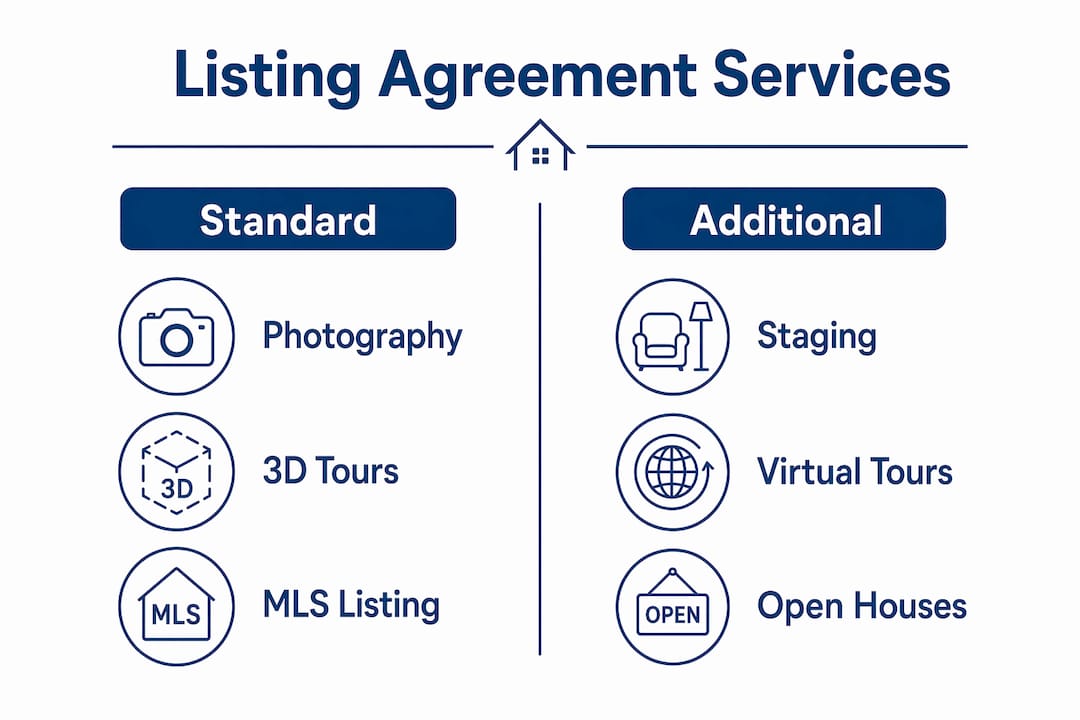
Key service questions to put to every agent:
Marketing strategies vary widely across agents. Some include professional photography and 3D tours as standard. Others treat them as add-ons. Agents who use professional photo editing services, such as those offered through platforms like Proofe, produce listing images that perform measurably better in online search results. In a market where most buyers begin their search on Zillow or Realtor.com, image quality directly affects showing volume.
Pro Tip: Ask to see three active or recently sold listings the agent currently markets. The quality of those listings, photos, descriptions, and digital presence, tells you more than any verbal answer.
This is where most sellers get hurt. The listing agreement is a legally binding contract, and Northern Virginia has specific requirements that make reading it carefully non-negotiable.
Here are the contract questions every seller should ask, in order of priority:
Automatic renewal clauses and cancellation terms are where sellers most often get locked into agreements they regret. An agent can include a clause that automatically extends the listing period unless you opt out within a specific window. Miss that window, and you are committed for another term.
| Contract element | What to ask |
|---|---|
| Listing type | Exclusive right to sell vs. exclusive agency: who owes commission if you find the buyer? |
| Termination date | Is there a definite end date, and does Virginia law require one? Yes, it does. |
| Cancellation fees | What do you owe if you exit early, and under what conditions? |
| Tail/safety clause | How long after expiry can the agent claim commission on introduced buyers? |
| Dual agency | Will the agent disclose and get written consent if representing both parties? |
Pro Tip: Even when a contract permits cancellation, tail clauses protect brokers from buyers introduced during the listing period who purchase after expiry. Ask for the exact tail period in writing before you sign.
An agent's suggested list price is not just a number. It is a strategic decision that reflects their understanding of your neighborhood, current buyer demand, and their own negotiation philosophy. Ask the wrong agent this question and you will get a flattering number designed to win your listing, not sell your home.
Questions that expose pricing discipline:
| Pricing approach | Best suited for |
|---|---|
| Below-market to generate bidding war | High-demand neighborhoods with low inventory, such as Reston Town Center area |
| At-market value pricing | Balanced markets where buyers are cautious and appraisal risk is higher |
| Above-market with room to negotiate | Unique properties with limited comparables and motivated but patient sellers |
An agent who cannot show you the comparable sales data behind their suggested price is guessing. In Fairfax County, where median prices and days-on-market shift significantly between zip codes and even subdivisions, pricing precision is the difference between a bidding war and a price reduction.
Transparent communication and responsiveness are the factors sellers most frequently cite when rating their experience with a listing agent. They are also the factors most sellers forget to ask about before signing.
Direct questions to ask every agent:
A team structure is not inherently a problem. Some of the best-performing agents in Northern Virginia operate with buyer's agents and transaction coordinators who handle specific parts of the process with real expertise. The problem arises when you sign expecting direct access to the listing agent and end up communicating with an assistant who has limited authority to make decisions.
Pro Tip: Ask the agent to describe the last difficult negotiation they handled and how it resolved. The specificity and confidence of their answer tells you far more about their actual skills than any credential or award.
Asking the right questions before signing a listing agreement is the most direct way to protect your sale outcome, your legal rights, and your working relationship with your agent.
| Point | Details |
|---|---|
| Verify local market knowledge | Ask for recent sales data specific to your neighborhood, not just general market stats. |
| Demand written service commitments | Get a written breakdown of every marketing service before signing the listing agreement. |
| Negotiate compensation | Commission rates average around 2.9% but are fully negotiable under current law. |
| Read cancellation and tail clauses | Understand exactly what you owe and for how long after the listing period ends. |
| Confirm written agreement compliance | Virginia law requires written agreements with definite termination dates. No exceptions. |
Most sellers I work with in Herndon and Reston come to me after a frustrating experience with a previous agent. The pattern is almost always the same. They chose someone based on a personal connection or a flashy presentation, signed the listing agreement without reading it carefully, and only discovered the gaps when something went wrong.
The single most overlooked question is about the tail clause. Sellers focus on the commission rate and the listing period, then are blindsided six months later when they owe a commission on a buyer their previous agent introduced, even though that agent is long gone. I have seen this cost sellers thousands of dollars on transactions they thought were clean.
The second pattern I see is sellers who never ask who they will actually be talking to. They meet a charismatic senior agent, sign with that person, and then spend the entire transaction communicating with a junior team member who has to check every decision. That is not necessarily wrong, but you deserve to know it upfront.
My honest advice: treat the agent interview like a job interview, because that is exactly what it is. You are hiring someone to manage one of the largest financial transactions of your life. The questions in this guide are not formalities. They are the filter that separates agents who will protect your interests from those who will simply process your transaction.
— Mazin

Sellers in Herndon, Reston, and Great Falls deserve an agent who knows the local market at the street level, not just the county level. Herndonhomeguide connects you directly with Mazin Abdelhameid, a Northern Virginia real estate professional with deep expertise in Fairfax County pricing, contract compliance, and digital marketing strategy. Use the questions in this guide during your agent interviews, then connect with a local expert who can answer every one of them with specifics, data, and a written commitment. Your home sale deserves that standard.
A listing agreement is a legally binding contract between a home seller and a real estate agent that authorizes the agent to market and sell the property. It specifies the listing price, services provided, compensation terms, and the agreement's duration.
Yes. Compensation is fully negotiable and not set by law. Listing commissions average around 2.9%, but sellers have the right to negotiate the rate before signing any agreement.
A tail clause, also called a safety clause or protection period, ensures agents receive commission if a buyer introduced during the listing period purchases the home after the contract expires. Always ask for the exact duration in writing.
Yes. Virginia law mandates written brokerage agreements with definite termination dates and full fee disclosures. Operating without one is a regulatory violation that exposes both the agent and the seller to legal risk.
Interview at least three agents before signing. Use a consistent set of questions for each so you can compare answers directly on experience, marketing approach, contract terms, and communication style.
A real estate agent coordinates the closing process by managing communication, deadlines, inspections, and paperwork across every party involved in the transaction. This coordination role is
What Does Real Estate Seasonality Mean for Buyers?Real estate seasonality is defined as the predictable annual cycle of fluctuations in buyer demand, home inventory, and prices that repeat at
Reston Homeowners Association: 2026 Resident GuideThe Reston Homeowners Association is the primary community organization governing property standards, amenities, and neighborhood rules for most
Work With a Buyer Agent Effectively in 2026A buyer's agent is defined as a licensed real estate professional who represents the buyer's legal and financial interests throughout the entire purchase
 Copyright© 2026 REIN Inc. Information Deemed Reliable But Not Guaranteed. The listings data displayed on this medium comes in part from the Real Estate Information Network Inc.(REIN) and has been authorized by participating listing Broker Members of REIN for display. REIN's listings are based upon Data submitted by its Broker Members, and REIN therefore makes no representation or warranty regarding the accuracy of the Data. All users of REIN's listings database should confirm the accuracy of
the listing information directly with the listing agent. Copyright ©2026 REIN. REIN's listings Data and information is protected under federal copyright laws.Federal law prohibits, among other acts, the unauthorized copying or alteration of, or preparation of derivative works from, all or any part of copyrighted materials, including certain compilations of Data and information. COPYRIGHT VIOLATORS MAY BE SUBJECT TO SEVERE FINES AND PENALTIES
UNDER FEDERAL LAW.
REIN updates its listings on a daily basis. Data last updated: September 21, 2026 1:27 PM UTC
Show More...
Copyright© 2026 REIN Inc. Information Deemed Reliable But Not Guaranteed. The listings data displayed on this medium comes in part from the Real Estate Information Network Inc.(REIN) and has been authorized by participating listing Broker Members of REIN for display. REIN's listings are based upon Data submitted by its Broker Members, and REIN therefore makes no representation or warranty regarding the accuracy of the Data. All users of REIN's listings database should confirm the accuracy of
the listing information directly with the listing agent. Copyright ©2026 REIN. REIN's listings Data and information is protected under federal copyright laws.Federal law prohibits, among other acts, the unauthorized copying or alteration of, or preparation of derivative works from, all or any part of copyrighted materials, including certain compilations of Data and information. COPYRIGHT VIOLATORS MAY BE SUBJECT TO SEVERE FINES AND PENALTIES
UNDER FEDERAL LAW.
REIN updates its listings on a daily basis. Data last updated: September 21, 2026 1:27 PM UTC
Show More...
 All or a portion of the multiple listing information is provided by the Central Virginia Regional Multiple Listing Service, LLC, from a copyrighted compilation of listings. All CVR MLS information provided is deemed reliable but is not guaranteed accurate. The compilation of listings and each individual listing are ©2026 Central Virginia Regional Multiple Listing Service, LLC. All rights reserved.
All MLS listings are © 2026 Central Virginia Regional Multiple Listing Service, LLC. All
rights reserved. No one may copy and/or repost these MLS listings, or any portion thereof, without the written permission of an authorized officer of the Central Virginia Regional Multiple Listing Service, LLC.
All listings with the CVRMLS logo are provided courtesy of the IDX program.
Last Updated: September 21, 2026 1:50 PM UTC
Show More...
All or a portion of the multiple listing information is provided by the Central Virginia Regional Multiple Listing Service, LLC, from a copyrighted compilation of listings. All CVR MLS information provided is deemed reliable but is not guaranteed accurate. The compilation of listings and each individual listing are ©2026 Central Virginia Regional Multiple Listing Service, LLC. All rights reserved.
All MLS listings are © 2026 Central Virginia Regional Multiple Listing Service, LLC. All
rights reserved. No one may copy and/or repost these MLS listings, or any portion thereof, without the written permission of an authorized officer of the Central Virginia Regional Multiple Listing Service, LLC.
All listings with the CVRMLS logo are provided courtesy of the IDX program.
Last Updated: September 21, 2026 1:50 PM UTC
Show More...
 © BRIGHT, All Rights Reserved
Information Deemed Reliable But Not Guaranteed
The data relating to real estate for sale on this website appears in part through the BRIGHT Internet Data Exchange program, a voluntary cooperative exchange of
property listing data between licensed real estate brokerage firms in which
participates, and is provided by BRIGHT through a licensing agreement.
The information provided by this website is for the personal,
non-commercial use of consumers and may not be used for any purpose other than to identify prospective properties consumers may be interested in purchasing.
Data last updated: September 21, 2026 12:41 PM UTC
Some properties which appear for sale on this website may no longer be available
because they are under contract, have Closed or are no longer being offered for sale.
Some real estate firms do not participate in IDX and their listings do not appear on this website. Some properties listed with participating firms do not appear on this website at the request of the seller.
Show More...
