
A real estate agent coordinates the closing process by managing communication, deadlines, inspections, and paperwork across every party involved in the transaction. This coordination role is

Dated: June 3 2026
Views: 65

Reviewing real estate contract terms means dissecting every clause in a purchase agreement to confirm you understand your rights, obligations, and exit options before you sign. The standard industry term for this document is the purchase and sale agreement, though buyers and sellers commonly call it the contract. Once signed, the agreement is binding with no general right to cancel, which makes the review window your single most powerful moment in any transaction. Miss a deadline, overlook a vague clause, or skip the contingency language, and you could forfeit your deposit or inherit a property defect you never agreed to accept.
Understanding real estate contracts starts with knowing what you are actually reading. A standard purchase and sale agreement contains several distinct sections, each carrying specific legal weight.
Purchase price and consideration define what you are paying and what the seller is delivering. These figures must match your negotiated offer exactly. Any discrepancy between the verbal agreement and the written contract controls the outcome, and the written version wins every time.
Earnest money is typically 1% to 3% of the purchase price, held by a neutral escrow agent until closing. That figure matters because it represents real money you can lose. The contract must spell out the exact conditions under which the deposit is refunded to you or forfeited to the seller. Vague language here is a red flag, not a minor oversight.
Contingencies are the most protective clauses in any buyer’s contract. The four most common are:
Contingencies act as exit ramps, allowing you to terminate the contract and recover your earnest money if you exercise them properly within their deadlines. Miss a deadline and that protection evaporates.
Closing date, possession, and cost allocation tell you when the transaction finalizes, when you get the keys, and who pays for what. Title insurance, transfer taxes, and prorations for property taxes and HOA fees all appear here. The ALTA settlement statement is your final accounting of every dollar exchanged at closing, and reviewing it before the closing table is non-negotiable.

Execution details matter more than most buyers realize. Real estate contracts must be in writing and properly signed to satisfy the Statute of Frauds and be legally enforceable. Confirm every required signature is present and that the property description matches the legal description on the deed.
| Key term | What to verify |
|---|---|
| Purchase price | Matches negotiated offer exactly |
| Earnest money | Amount, escrow agent, refund and forfeiture triggers |
| Contingencies | Type, deadline, and notice requirements |
| Closing date | Realistic timeline with possession date confirmed |
| Signatures | All parties signed, property legally described |
Pro Tip: Read the effective date carefully. The effective date is the day both parties have signed, and it starts the clock on every contingency deadline in the contract.
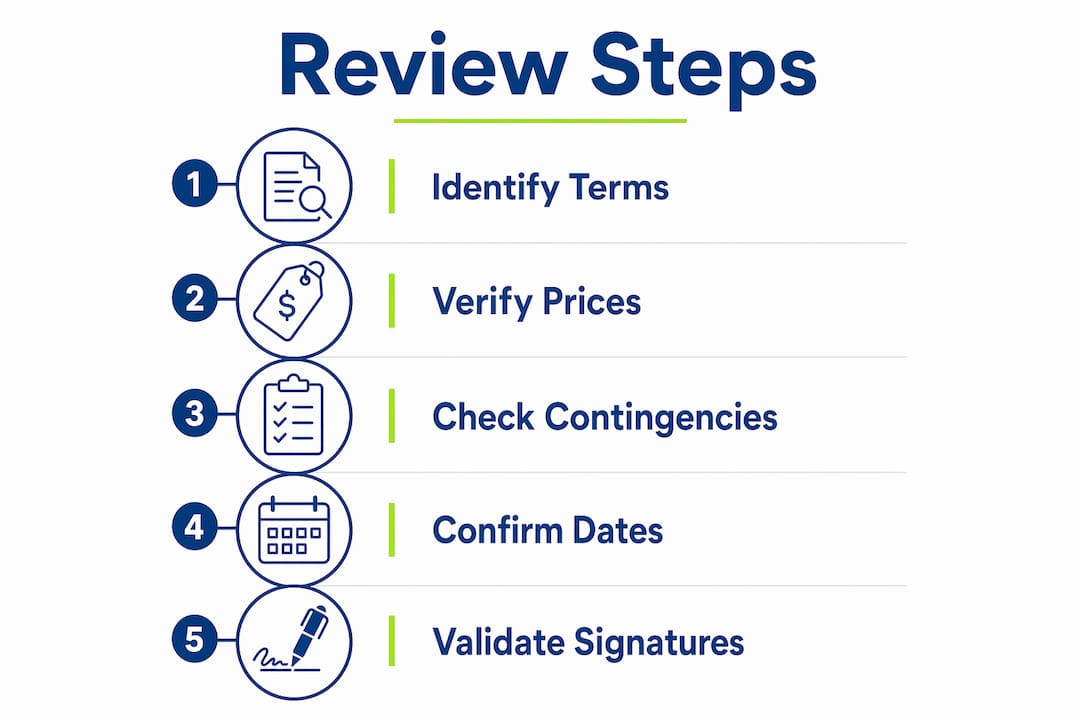
A systematic approach prevents the most common and costly mistakes. Work through the contract in this order:
Verify the parties and property description. Confirm that your legal name, the seller’s legal name, and the property’s legal description are all accurate. A typo in the property address or a missing middle initial can create title problems later.
Check the purchase price and deposit terms. Confirm the agreed price, the earnest money amount, the name of the escrow agent, and the deadline for delivering the deposit. Verify the refund conditions are written clearly.
Map every contingency deadline. List each contingency, its deadline, and the required notice method. Effective date and signature timing start contingency deadlines, so even a one-day difference can shorten your inspection or financing window.
Read seller disclosures and as-is clauses. An as-is clause shifts property condition risk to you as the buyer, but it does not remove the seller’s obligation to disclose known defects. Confirm that disclosures are attached and complete before you proceed.
Review closing timelines and cost allocations. Identify who pays for owner’s title insurance, transfer taxes, and settlement fees. Owner’s title insurance typically costs 0.5% to 1% of the purchase price, so this is not a trivial line item.
Build a milestone checklist. Contract review checklists organized by timeline milestones help you track rights and deadlines, preventing costly missed actions. Key checkpoints include contract signing, inspection period end, financing deadline, title review, and closing day.
Pro Tip: Create a simple calendar with every deadline from the contract entered the same day you receive it. Color-code contingency deadlines in red. Missing one by even 24 hours can cost you your deposit.
Most contract disputes trace back to language that seemed minor at signing. Knowing what to look for protects you before the problem starts.
“Many contract disputes stem from misunderstandings; thorough review clarifies remedies, contingencies, and obligations, reducing litigation risk.” — Do I Need A Lawyer To Review Real Estate Contract?
Ignoring attorney review periods is another frequent mistake. In states like Illinois, attorney review periods of typically 5 business days allow either party to propose changes or, in some cases, walk away without penalty. Treating this window as optional rather than strategic leaves protection on the table.
Negotiating real estate contracts is not confrontational. It is a normal part of the transaction, and sellers expect it. The key is knowing what to ask for and how to document it properly.
Use the attorney review period. If your state offers one, this is your formal window to propose changes without breaching the contract. Attorney review periods are critical, not ceremonial, often addressing ambiguous inspection and financing terms that directly affect your protections.
Prioritize the highest-risk clauses first. Focus negotiation energy on contingency deadlines, repair obligations, and earnest money conditions. These three areas generate the most disputes and carry the most financial exposure.
Request changes in writing through addenda. Every modification to a signed contract requires a written addendum signed by both parties. Verbal agreements about repairs, credits, or closing date changes are unenforceable.
Understand what sellers will typically accept. Closing date flexibility, repair credits rather than physical repairs, and extended financing contingencies are commonly negotiated. Sellers are less likely to accept changes that reopen pricing or add new contingencies after an offer is accepted.
Document all communications. Keep every email, text, and written request related to contract changes. If a dispute arises, your paper trail is your evidence.
Pro Tip: When requesting repairs after an inspection, ask for a credit at closing rather than seller-completed repairs. You control the quality of the work, and the transaction moves faster.
Protecting yourself starts before you sign and continues through closing day.
Pro Tip: If you are buying in Herndon, Reston, or Northern Virginia, local market customs around contingencies and closing costs differ from national norms. Work with an agent who knows the regional contract standards, not just the general ones.
Reviewing real estate contract terms before signing is the single most effective way to protect your deposit, your rights, and your investment.
| Point | Details |
|---|---|
| Contingencies are your exit rights | Each contingency needs a specific deadline and written notice method to be enforceable. |
| Earnest money terms must be explicit | Confirm refund and forfeiture conditions are written clearly before you deliver any deposit. |
| Effective date starts the clock | Contingency deadlines begin on the effective date, not the day you receive the contract. |
| Negotiate before signing | Post-signing changes require mutual written consent; your leverage disappears once you sign. |
| Attorney review is strategic | Use the attorney review period to address ambiguous clauses, not just to read the document. |
Most buyers treat the contract review as a formality. They skim it, trust that their agent caught everything, and sign. That approach has cost people I have worked with real money, and it is entirely avoidable.
The detail that surprises buyers most is how much the effective date controls. I have seen financing contingencies shrink from 21 days to 18 days simply because the contract was countersigned two days after the buyer assumed the clock started. Those three days matter when a lender needs time to process an appraisal.
The second thing I tell every buyer: read the default provisions before you read anything else. Most people skip to the price and contingencies. But the default section tells you what actually happens if something goes wrong, and that language is rarely buyer-friendly in a standard form contract. Knowing your remedies before you need them is the difference between a resolved dispute and an expensive one.
Negotiation leverage exists before signing and essentially disappears after. I have helped buyers negotiate extended inspection periods, seller repair credits, and modified earnest money forfeiture terms, but only because we identified those issues during the review phase. Once the ink is dry, the conversation changes entirely.
Trust the contract language, not the verbal assurances. If a seller’s agent tells you “don’t worry about that clause, it never comes up,” get the clause changed in writing. What never comes up has a way of coming up at the worst possible moment.
— Mazin

Real estate contracts in Herndon, Reston, and the surrounding Northern Virginia communities carry local customs around contingencies, closing costs, and disclosure requirements that differ from what you will find in a generic online guide. At Herndonhomeguide, Mazin Abdelhameid works directly with buyers and sellers to review contract language, flag problematic clauses, and negotiate terms that protect your interests from offer to closing. Whether you are purchasing your first home or managing a complex sale, having an experienced local agent in your corner during the contract review phase is the most cost-effective protection available. Connect with Herndonhomeguide today to get expert guidance on your next transaction.
Reviewing real estate contract terms means reading every clause in a purchase and sale agreement to confirm you understand your obligations, rights, contingency deadlines, and exit conditions before signing. Once signed, the contract is binding with no general right to cancel.
Review timelines vary by state and transaction. Some states, like Illinois, provide a formal attorney review period of typically 5 business days after signing during which changes can be proposed. Outside of that window, any modification requires mutual written consent from both parties.
The most critical terms are the contingency deadlines, earnest money conditions, as-is clauses, repair obligations, and the effective date. These five areas generate the most disputes and carry the greatest financial exposure for buyers.
Post-signing changes require a written addendum signed by both parties. Verbal agreements about repairs, credits, or closing date adjustments are unenforceable. Your negotiation leverage is strongest before you sign, not after.
An attorney is not legally required in most states, but a one-hour consultation costs far less than losing a deposit or inheriting an undisclosed defect. Attorney review periods, where available, are designed specifically to give you professional oversight before the contract becomes fully binding.
A real estate agent coordinates the closing process by managing communication, deadlines, inspections, and paperwork across every party involved in the transaction. This coordination role is
What Does Real Estate Seasonality Mean for Buyers?Real estate seasonality is defined as the predictable annual cycle of fluctuations in buyer demand, home inventory, and prices that repeat at
Reston Homeowners Association: 2026 Resident GuideThe Reston Homeowners Association is the primary community organization governing property standards, amenities, and neighborhood rules for most
Work With a Buyer Agent Effectively in 2026A buyer's agent is defined as a licensed real estate professional who represents the buyer's legal and financial interests throughout the entire purchase
 Copyright© 2026 REIN Inc. Information Deemed Reliable But Not Guaranteed. The listings data displayed on this medium comes in part from the Real Estate Information Network Inc.(REIN) and has been authorized by participating listing Broker Members of REIN for display. REIN's listings are based upon Data submitted by its Broker Members, and REIN therefore makes no representation or warranty regarding the accuracy of the Data. All users of REIN's listings database should confirm the accuracy of
the listing information directly with the listing agent. Copyright ©2026 REIN. REIN's listings Data and information is protected under federal copyright laws.Federal law prohibits, among other acts, the unauthorized copying or alteration of, or preparation of derivative works from, all or any part of copyrighted materials, including certain compilations of Data and information. COPYRIGHT VIOLATORS MAY BE SUBJECT TO SEVERE FINES AND PENALTIES
UNDER FEDERAL LAW.
REIN updates its listings on a daily basis. Data last updated: September 21, 2026 1:27 PM UTC
Show More...
Copyright© 2026 REIN Inc. Information Deemed Reliable But Not Guaranteed. The listings data displayed on this medium comes in part from the Real Estate Information Network Inc.(REIN) and has been authorized by participating listing Broker Members of REIN for display. REIN's listings are based upon Data submitted by its Broker Members, and REIN therefore makes no representation or warranty regarding the accuracy of the Data. All users of REIN's listings database should confirm the accuracy of
the listing information directly with the listing agent. Copyright ©2026 REIN. REIN's listings Data and information is protected under federal copyright laws.Federal law prohibits, among other acts, the unauthorized copying or alteration of, or preparation of derivative works from, all or any part of copyrighted materials, including certain compilations of Data and information. COPYRIGHT VIOLATORS MAY BE SUBJECT TO SEVERE FINES AND PENALTIES
UNDER FEDERAL LAW.
REIN updates its listings on a daily basis. Data last updated: September 21, 2026 1:27 PM UTC
Show More...
 All or a portion of the multiple listing information is provided by the Central Virginia Regional Multiple Listing Service, LLC, from a copyrighted compilation of listings. All CVR MLS information provided is deemed reliable but is not guaranteed accurate. The compilation of listings and each individual listing are ©2026 Central Virginia Regional Multiple Listing Service, LLC. All rights reserved.
All MLS listings are © 2026 Central Virginia Regional Multiple Listing Service, LLC. All
rights reserved. No one may copy and/or repost these MLS listings, or any portion thereof, without the written permission of an authorized officer of the Central Virginia Regional Multiple Listing Service, LLC.
All listings with the CVRMLS logo are provided courtesy of the IDX program.
Last Updated: September 21, 2026 1:50 PM UTC
Show More...
All or a portion of the multiple listing information is provided by the Central Virginia Regional Multiple Listing Service, LLC, from a copyrighted compilation of listings. All CVR MLS information provided is deemed reliable but is not guaranteed accurate. The compilation of listings and each individual listing are ©2026 Central Virginia Regional Multiple Listing Service, LLC. All rights reserved.
All MLS listings are © 2026 Central Virginia Regional Multiple Listing Service, LLC. All
rights reserved. No one may copy and/or repost these MLS listings, or any portion thereof, without the written permission of an authorized officer of the Central Virginia Regional Multiple Listing Service, LLC.
All listings with the CVRMLS logo are provided courtesy of the IDX program.
Last Updated: September 21, 2026 1:50 PM UTC
Show More...
 © BRIGHT, All Rights Reserved
Information Deemed Reliable But Not Guaranteed
The data relating to real estate for sale on this website appears in part through the BRIGHT Internet Data Exchange program, a voluntary cooperative exchange of
property listing data between licensed real estate brokerage firms in which
participates, and is provided by BRIGHT through a licensing agreement.
The information provided by this website is for the personal,
non-commercial use of consumers and may not be used for any purpose other than to identify prospective properties consumers may be interested in purchasing.
Data last updated: September 21, 2026 12:41 PM UTC
Some properties which appear for sale on this website may no longer be available
because they are under contract, have Closed or are no longer being offered for sale.
Some real estate firms do not participate in IDX and their listings do not appear on this website. Some properties listed with participating firms do not appear on this website at the request of the seller.
Show More...
